Responsibilities
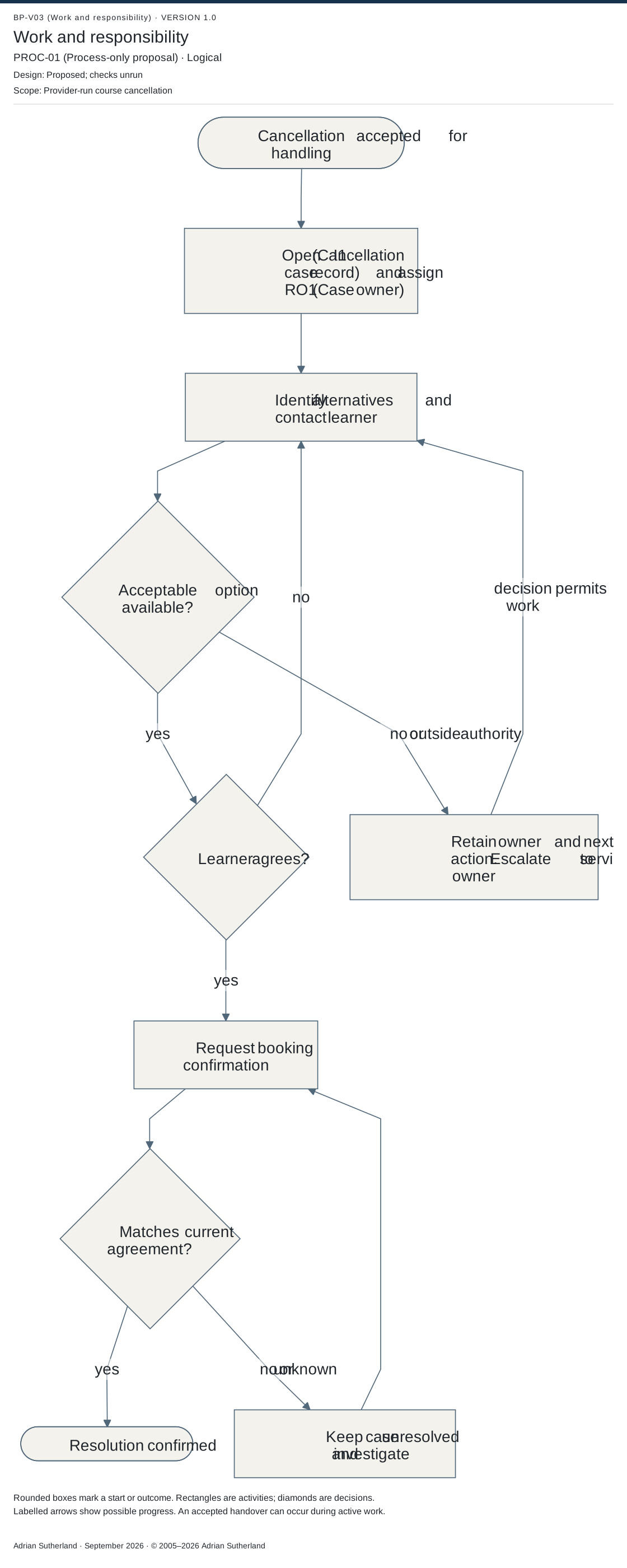
PR1 (Resolution process) carries out the resolution work. RO1 (Case owner) maintains I1 (Cancellation case record) until resolution is confirmed or an explicitly accepted transfer takes effect. OP-D1 (Accepted-transfer procedure) defines that transfer: the receiver checks the current record, authority, access and capacity; the shared record retains the effective acceptance and history.
| Role | Responsibility and decision |
|---|---|
| Learner | Chooses whether an alternative meets their need. |
| Booking and course teams | Identify alternatives and provide the booking confirmation. |
| Case owner | Maintains the record, contacts the learner and progresses resolution within the agreed scope. |
| Receiving case owner | Accepts the current version and next action or returns a query. |
| Duty coordinator | Arranges suitable cover; unresolved capacity or authority gaps reach the service owner. |
| Service owner | Agrees meaning, scope, service readiness and unresolved exceptions. |
| Data steward | Maintains definitions and coordinates recurring quality problems. |
The coordinator is a responsibility that could sit in an existing role. Named staff, cover and response targets remain to be agreed. V1 (Two-handover check) and OP-V1 (Handover checks) specify unrun checks of two handovers and the related organisational failures.
Customers and channels
CU-D1 (Customer roles) distinguishes the learner, payer and representative. Paying for a course does not establish the learner’s agreement; a representative needs explicit authority for the information and actions involved.
CH-D1 (Cross-channel journey) keeps the same case and meaning through a cancellation message and an assisted call. A sent message is not agreement. CH-S1 (Pending and accepted actions) requires a later mobile client to distinguish a locally saved proposal from accepted service state. A reconnecting client must handle a changed case or withdrawn permission. CU-F1 (Channel research) would test whether online and assisted routes allow the same choice; that research has not been run.
Partners
SU-D1 (Partner responsibilities) describes the later partner arrangement. Before PART-01 (Partner extension) can be introduced, the provider and partner must agree who may offer, reserve, confirm, change or cancel a place; what information may be shared; and who resolves unknown or disputed outcomes. The internal case owner retains responsibility for resolution.
L1 (Partner confirmation gap) is the hypothetical finding that exposes an unagreed partner-confirmation responsibility. Partner courses and refunds remain escalations in PROC-01 (Process-only proposal). SU-X1 (Partner exit exercise) would exercise exit with an open case, retained commitments and removal of the previous partner’s access. Its result is unrun.
Connected records
The Process example owns the handover procedure. Customer, Channel and Supplier records retain the wider decisions. Follow the case lifecycle and the software acceptance contract to see how these responsibilities are preserved.